Sam Young Sam Young
0 Course Enrolled • 0 Course CompletedBiography
ユニークなCKAD基礎訓練試験-試験の準備方法-素晴らしいCKAD日本語試験情報
2025年JPNTestの最新CKAD PDFダンプおよびCKAD試験エンジンの無料共有:https://drive.google.com/open?id=1RUXhUKsEg96SZrk3MweC9v5HvqenGnhJ
CKAD学習ガイドは世界を対象としており、ユーザーは非常に広範囲です。ユーザーにより良い体験を提供するために、私たちは常に改善しています。 CKAD試験準備の高い品質と効率は、ユーザーに認められています。当社のCKADテスト資料の高い合格率は最大の特徴です。 CKAD試験準備を使用している限り、必要なものを確実に収集できます。最短時間でCKAD試験に合格できるだけでなく、夢のあるCKAD認定資格を取得して将来を明るくすることもできます。
CKAD試験の準備をするために、候補者は、Kubernetesの基礎を強く理解し、生産環境でKubernetesとの仕事の経験を持つことをお勧めします。 Linux Foundationは、候補者が試験の準備を支援するために、幅広いトレーニングリソースとコースを提供しています。さらに、ブログ、フォーラム、オンラインミートアップなどの多くのコミュニティリソースを利用でき、候補者が試験を受けた他の人の経験から学習するのに役立ちます。
Linux Foundation認定Kubernetesアプリケーション開発者(CKAD)認定試験は、候補者のKubernetes上でのクラウドネイティブアプリケーション開発の知識とスキルをテストするように設計されています。Kubernetesは、プロダクション環境でコンテナ化されたアプリケーションを管理するための事実上の標準となったオープンソースのコンテナオーケストレーションシステムです。Kubernetesスキルの需要が増加するにつれて、CKAD認定は、Kubernetesアプリケーション開発の専門知識を示したい開発者にとって人気のある選択肢となっています。
CKAD日本語試験情報 & CKAD資格試験
何事でもはじめが一番難しいです。CKAD試験への復習に悩んでいますか?弊社の提供するソフトを買うのはあなたの必要の第一歩です。弊社の保証がある問題集を入手して、試験に合格するチャンスが大きくなります。疑問がありましたら、JPNTestで無料のデモをダウンロードしてやってみることができます。
Linux Foundation Certified Kubernetes Application Developer(CKAD)試験は、Kubernetesで作業している開発者のスキルと知識を検証するために設計された認定プログラムです。Kubernetesは、コンテナ化されたアプリケーションの管理と展開の業界標準となっているオープンソースのコンテナオーケストレーションプラットフォームです。この認定プログラムは、クラウドネイティブアプリケーションをKubernetesに設計、構築、構成、公開する候補者の能力をテストします。
Linux Foundation Certified Kubernetes Application Developer Exam 認定 CKAD 試験問題 (Q62-Q67):
質問 # 62
You are tasked with deploying an application with a deployment named 'web-app' that requires a specific SecurityContext to run. The application should be able to access a specific hostPath volume mounted at '/data' and should be able to run as a non-root user with a specific UID. You need to define the Securitycontext in your Deployment configuration to ensure the application runs with the required privileges and access.
正解:
解説:
See the solution below with Step by Step Explanation.
Explanation:
Solution (Step by Step) :
1. Define the Securitycontext in the Deployment YAML:
- Create a 'securityContext' section within the 'spec-template.spec.containerss block for your application container
- Set the 'runAsLJser' field to the desired non-root IJID (e.g., 1000).
- Specify 'allowPrivilegeEscalatiom false' to prevent the container from escalating its privileges beyond the defined CJID.
- Add a 'hostPatm volume mount with 'readOnly: false' to allow the application to read and write to the mounted directory.
- Define a 'volume' with the 'hostPath' type, specifying the source path (e.g., ',/data') and the path within the container where it should be mounted.
2. Create the Deployment: - Apply the Deployment YAML file using 'kubectl apply -f web-app-deployment.yamr 3. Verify the Deployment - Check the status of the Deployment using 'kubectl get deployments web-app'. You should see a running pod with the specified Securitycontext. - Use kubectl describe pod' to inspect the details of the pod and verify that the Securitycontext is applied correctly. 4. Test the Application: - Ensure that your application can access and modify the '/data' volume with the specified user ID (1000). - The 'securitycontext' allows you to define security settings for the application container, such as user ID and privilege escalation- - 'runAsIJsers specifies the IJID under which the container should run. - 'allowPrivilegeEscalation' controls whether the container can elevate its privileges beyond the specified IJID. - 'hostPath' volume mounts allow containers to access directories on the host system. - 'readOnly' determines whether the volume mount iS read-only or read-write. - Ensure your container image has the necessary permissions to access the hostPath volume within the specified UID.
質問 # 63
Refer to Exhibit.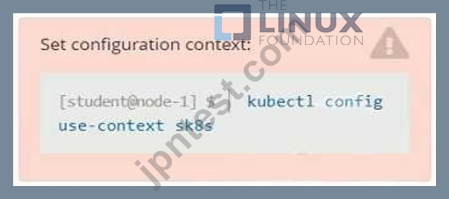
Context
A project that you are working on has a requirement for persistent data to be available.
Task
To facilitate this, perform the following tasks:
* Create a file on node sk8s-node-0 at /opt/KDSP00101/data/index.html with the content Acct=Finance
* Create a PersistentVolume named task-pv-volume using hostPath and allocate 1Gi to it, specifying that the volume is at /opt/KDSP00101/data on the cluster's node. The configuration should specify the access mode of ReadWriteOnce . It should define the StorageClass name exam for the PersistentVolume , which will be used to bind PersistentVolumeClaim requests to this PersistenetVolume.
* Create a PefsissentVolumeClaim named task-pv-claim that requests a volume of at least 100Mi and specifies an access mode of ReadWriteOnce
* Create a pod that uses the PersistentVolmeClaim as a volume with a label app: my-storage-app mounting the resulting volume to a mountPath /usr/share/nginx/html inside the pod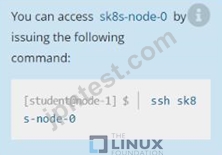
正解:
解説:
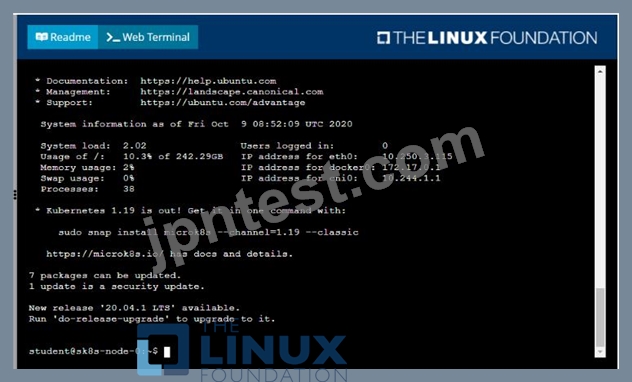
Solution:

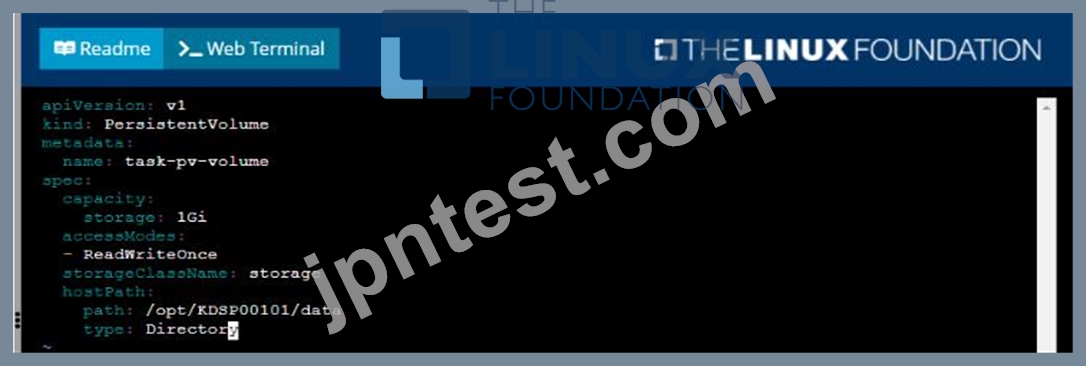
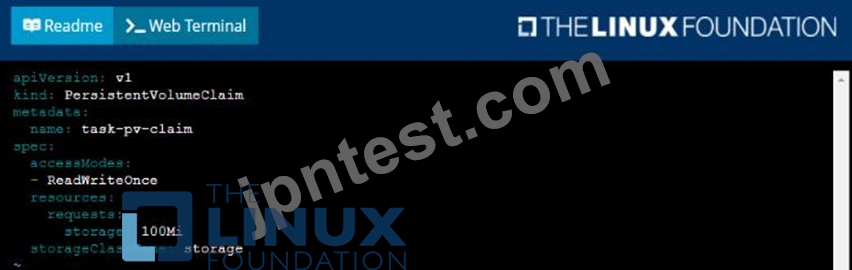
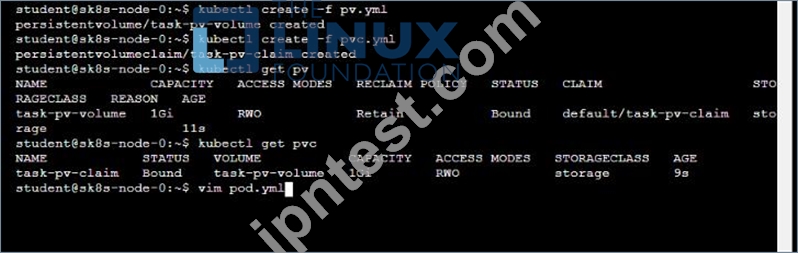
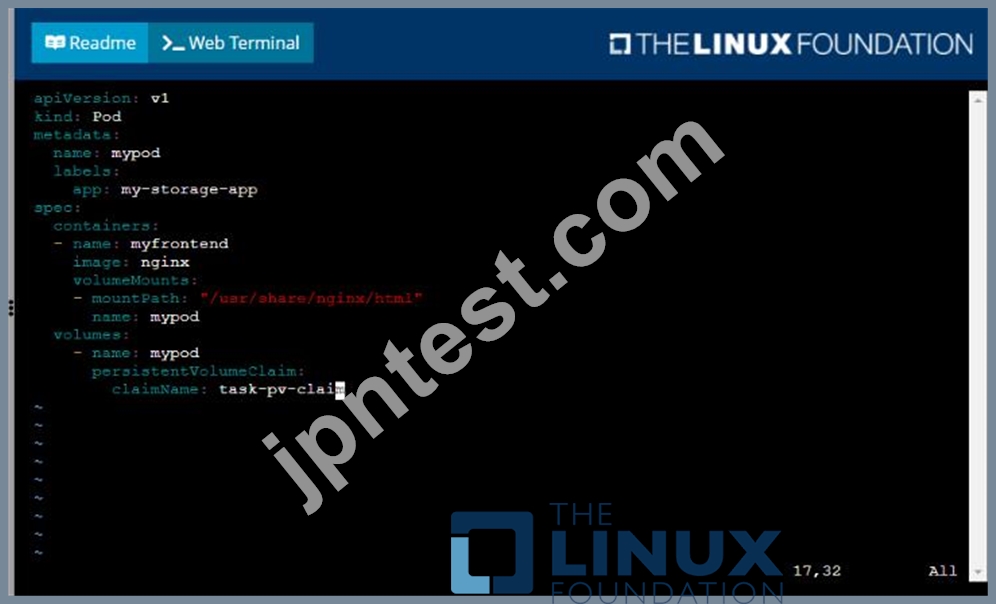

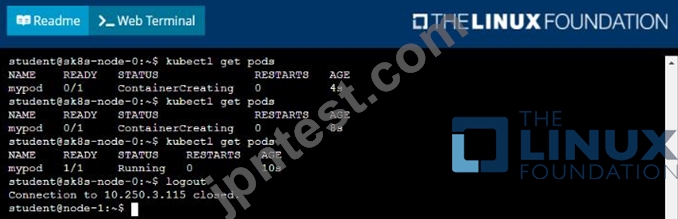
質問 # 64
Context
Task:
1) First update the Deployment cka00017-deployment in the ckad00017 namespace:
To run 2 replicas of the pod
Add the following label on the pod:
Role userUI
2) Next, Create a NodePort Service named cherry in the ckad00017 nmespace exposing the ckad00017-deployment Deployment on TCP port 8888
正解:
解説:
Solution: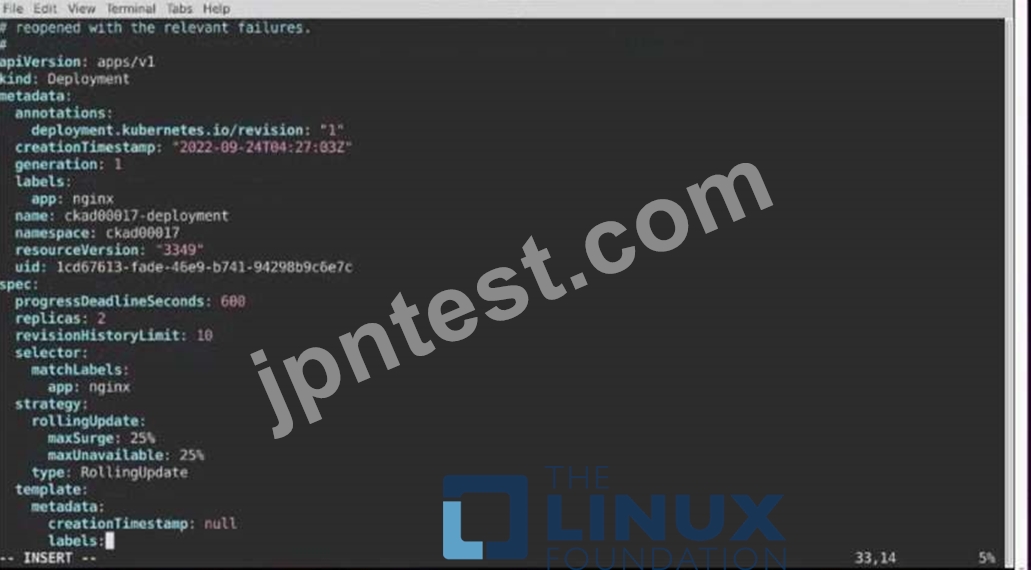
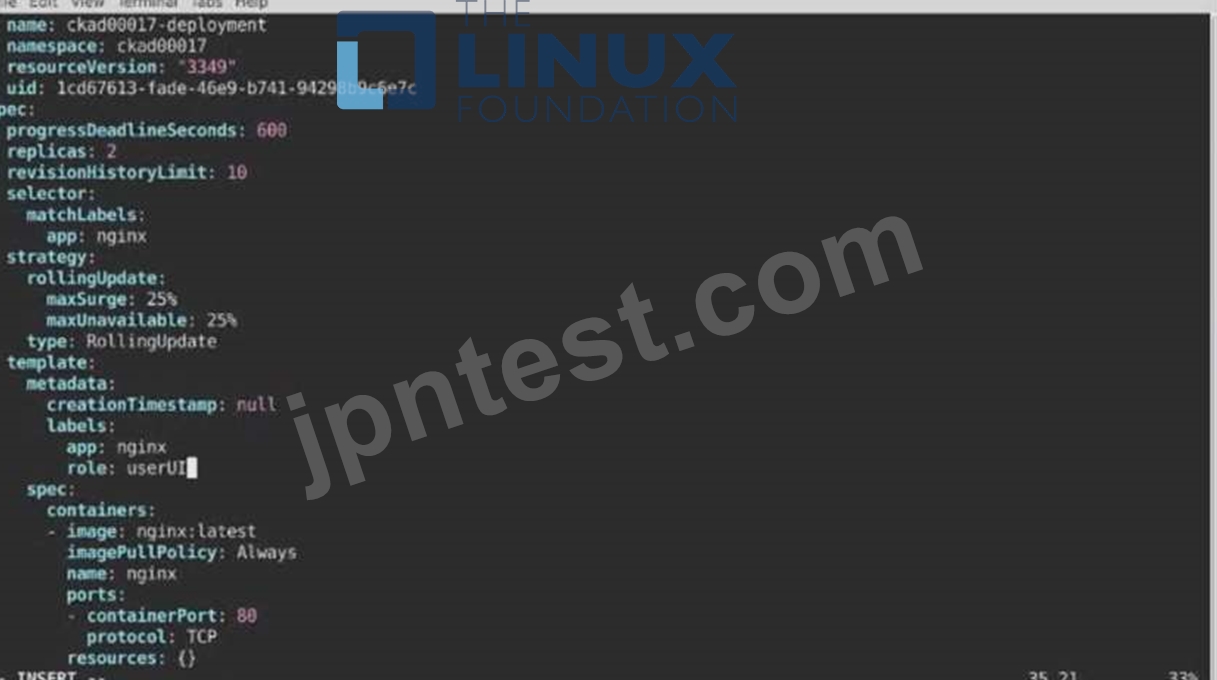
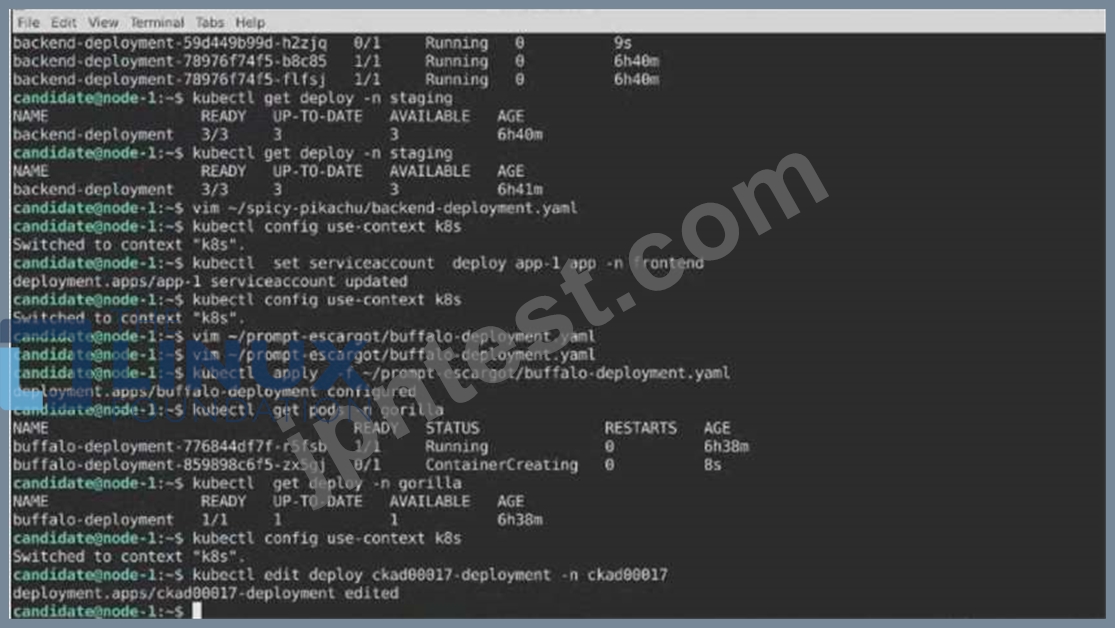
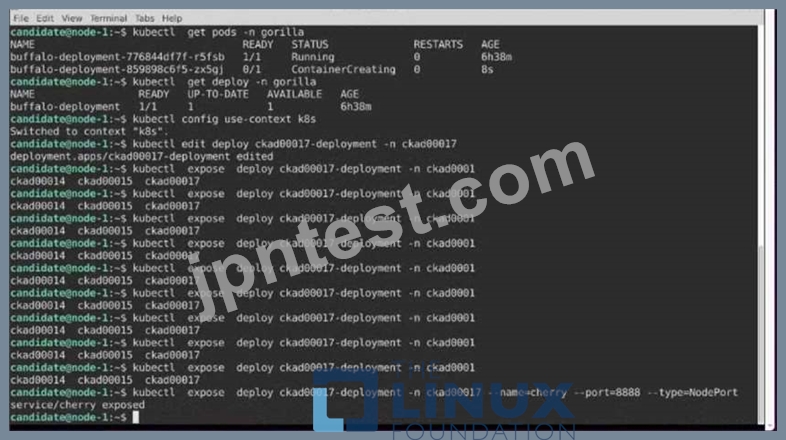
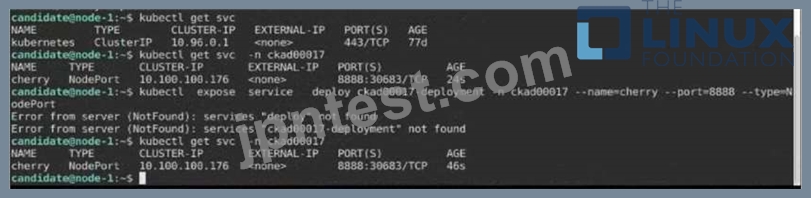
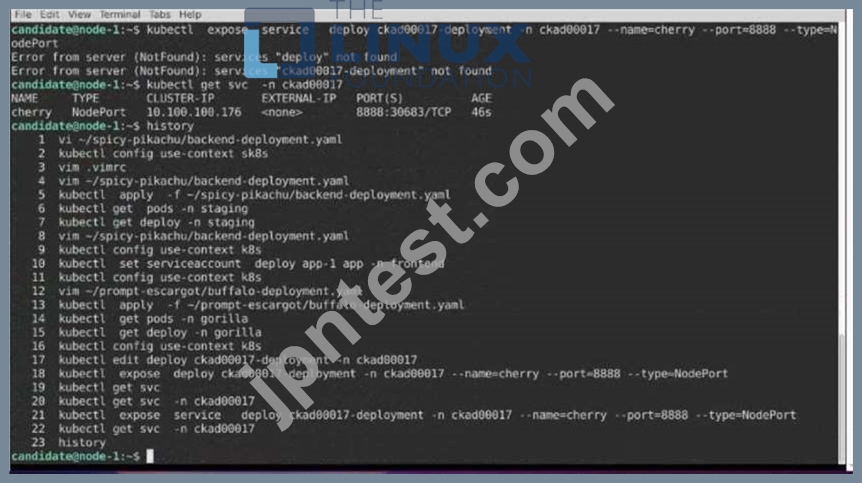
質問 # 65
You have a Deployment named 'my-app-deployment' that runs 3 replicas of a Spring Boot application. This application needs to access a PostgreSQL database hosted on your Kubernetes cluster. You need to create a Custom Resource Definition (CRD) to define a new resource called 'Database' to represent the PostgreSQL database instances within your cluster. This CRD should include fields for specifying the database name, username, password, and the host where the database is deployed. Further, you need to configure the 'my- app-deployment' to use the 'Database' resource to connect to the PostgreSQL instance dynamically.
正解:
解説:
See the solution below with Step by Step Explanation.
Explanation:
Solution (Step by Step) :
1. Define the CRD:
- Create a YAML file named 'database.crd.yaml' to define the "Database' resource:
2. the CRD: - Apply tre 'database.cre.yaml' using 'kubectl "ply -f database.crd.ya'mr 3. Create A Database Instance: - 'eate YAML file 'd:tabaseyarnl' to define a database instance
4. Apply the Database Instance: - Apply the 'database.yaml' using 'kubectl apply -f database.yamr 5. IJpdate the Deployment - Update the Amy-app-deployment.yaml' to use the 'Database' resource:
6. Apply the Updated Deployment: - Apply the updated 'my-app-deployment.yamr using 'kubectl apply -f my-app-deployment.yamr 7. Verify the Configuration: - Use 'kubectl get databases to check the database instance. - Use 'kubectl describe pod -l app=my-app' to verify that the pods are using the values from the 'Database' resource tor connecting to the PostgreSQL database. This approach demonstrates how to utilize CRDs to define custom resources in Kubernetes and how to connect applications dynamically to these resources. The CRO ensures proper definition of the database resource, while the deployment utilizes the 'fieldRef mechanism to access and retrieve database connection details directly from the CRD, enabling dynamic configuration and simplification of application setup.,
質問 # 66
You have a Deployment named 'web-app-deployments that runs a web application in a containerized environment. The application is designed for high availability and scalability, but you need to ensure that no more than two pods are ever terminated simultaneously during a rolling update process. This is to minimize the impact on service availability during the update. How would you implement this rolling update strategy using Deployment resources?
正解:
解説:
See the solution below with Step by Step Explanation.
Explanation:
Solution (Step by Step) :
I). Update the Deployment YAML:
- Modify the 'strategy.roIIinglJpdate' section of the Deployment YAML to configure the rolling update behavior.
- Set 'maxunavailable: 1 ' to allow only one pod to be unavailable at a time during the update.
- Set 'maxSurge: 1 ' to permit only one additional pod to be created beyond the desired replica count during the update.
2. Apply the Updated Deployment: - Use ' kubectl apply -f web-app-deployment-yamr to update the Deployment. 3. Monitor the Rolling Update: - Observe the pod updates using 'kubectl get pods -I app=web-app' - You will see that during the rolling update, only one pod is terminated, while one new pod is created, ensuring that no more than two pods are ever terminated at the same time. 4. Verify the Update: - Once the rolling update is complete, check the 'updatedReplicaS field in the Deployment description Ckubectl describe deployment web-app- deployment) to verify that it matches the 'replicas' field.
質問 # 67
......
CKAD日本語試験情報: https://www.jpntest.com/shiken/CKAD-mondaishu
- 最高のLinux Foundation CKAD基礎訓練 - 合格スムーズCKAD日本語試験情報 | 大人気CKAD資格試験 🥎 【 www.it-passports.com 】で➠ CKAD 🠰を検索して、無料で簡単にダウンロードできますCKAD学習資料
- 完璧なCKAD基礎訓練一回合格-信頼的なCKAD日本語試験情報 👛 ウェブサイト▶ www.goshiken.com ◀から✔ CKAD ️✔️を開いて検索し、無料でダウンロードしてくださいCKAD日本語版受験参考書
- CKAD認定テキスト 🐒 CKAD資格関連題 💇 CKAD資格復習テキスト 🤿 ➽ www.jpexam.com 🢪で➽ CKAD 🢪を検索し、無料でダウンロードしてくださいCKAD練習問題
- CKAD日本語試験対策 🚊 CKAD模擬問題 🧁 CKAD日本語試験対策 🏅 検索するだけで➤ www.goshiken.com ⮘から➡ CKAD ️⬅️を無料でダウンロードCKAD模擬問題集
- 真実的-ハイパスレートのCKAD基礎訓練試験-試験の準備方法CKAD日本語試験情報 🧶 ▶ www.japancert.com ◀から➡ CKAD ️⬅️を検索して、試験資料を無料でダウンロードしてくださいCKAD試験感想
- CKAD試験の準備方法|検証するCKAD基礎訓練試験|ユニークなLinux Foundation Certified Kubernetes Application Developer Exam日本語試験情報 ⏫ 【 www.goshiken.com 】で使える無料オンライン版⏩ CKAD ⏪ の試験問題CKAD資格復習テキスト
- CKAD模擬トレーリング ✊ CKAD資格復習テキスト 🏵 CKAD試験感想 📽 { jp.fast2test.com }は、[ CKAD ]を無料でダウンロードするのに最適なサイトですCKAD問題と解答
- CKAD専門知識 🌐 CKAD模擬トレーリング 🙆 CKAD認定テキスト 🔡 「 www.goshiken.com 」から▶ CKAD ◀を検索して、試験資料を無料でダウンロードしてくださいCKAD模擬問題集
- CKADソフトウエア 🌰 CKAD予想試験 🥘 CKAD専門知識 🎱 「 www.jpshiken.com 」サイトにて⮆ CKAD ⮄問題集を無料で使おうCKAD専門知識
- CKAD模擬トレーリング 🎑 CKAD合格受験記 ⭐ CKAD模擬問題集 ⛄ 最新⏩ CKAD ⏪問題集ファイルは➥ www.goshiken.com 🡄にて検索CKAD模擬問題集
- CKAD予想試験 🕔 CKAD対応受験 🤶 CKAD専門知識 🈵 ⮆ CKAD ⮄を無料でダウンロード▛ www.japancert.com ▟で検索するだけCKAD問題と解答
- myportal.utt.edu.tt, myportal.utt.edu.tt, myportal.utt.edu.tt, myportal.utt.edu.tt, myportal.utt.edu.tt, myportal.utt.edu.tt, myportal.utt.edu.tt, myportal.utt.edu.tt, myportal.utt.edu.tt, myportal.utt.edu.tt, myportal.utt.edu.tt, myportal.utt.edu.tt, myportal.utt.edu.tt, myportal.utt.edu.tt, myportal.utt.edu.tt, myportal.utt.edu.tt, myportal.utt.edu.tt, myportal.utt.edu.tt, www.stes.tyc.edu.tw, jsfury.com, www.stes.tyc.edu.tw, ncon.edu.sa, myportal.utt.edu.tt, myportal.utt.edu.tt, myportal.utt.edu.tt, myportal.utt.edu.tt, myportal.utt.edu.tt, myportal.utt.edu.tt, myportal.utt.edu.tt, myportal.utt.edu.tt, myportal.utt.edu.tt, vioeducation.com, global.edu.bd, www.stes.tyc.edu.tw, Disposable vapes
ちなみに、JPNTest CKADの一部をクラウドストレージからダウンロードできます:https://drive.google.com/open?id=1RUXhUKsEg96SZrk3MweC9v5HvqenGnhJ